

How to get tested for ADHD as an adult: what the evaluation involves and how much it costs


Getting tested for ADHD as an adult requires completing a clinical evaluation. A medical provider reviews your symptom history, checks it against DSM-5 criteria, and has you fill out a questionnaire called the ASRS. From there, they rule out other causes. Most adults seeking clarity on their ADHD symptoms start with a primary care provider.
About 6.0% of U.S. adults have a current ADHD diagnosis, and 55.9% of them received it at age 18 or older. If you are looking into how to get tested for ADHD in your thirties or forties, most diagnosed adults started where you are.
Key facts about adult ADHD testing
- What it is: an interview, a questionnaire, a review of your childhood history, and a check for other causes.
- Who runs it: a primary care provider, a psychiatrist, or a psychologist.
- The adult threshold: five symptoms of inattention or five of hyperactivity and impulsivity, several before age 12, affecting two or more settings.
- Time and cost: one to three appointments over two to six weeks, commonly a few hundred dollars before insurance. Evaluation costs depend on the provider, number of appointments and any additional testing. Insurance coverage and out-of-pocket costs depend on your plan and the services provided.
An adult ADHD evaluation has four parts
When being evaluated for adult ADHD, you’ll be asked for four kinds of information: a clinical interview, a standardized questionnaire, a childhood history, and a check for other conditions that may cause similar symptoms.
The CDC notes that there is no single test to diagnose ADHD, which is why your provider needs to be thorough with this process.
The clinical interview is the core of the evaluation
An interview will take up most of your evaluation appointment. Your provider will ask about your attention, organization, and how you follow-through and complete your responsibilities in your day-to-day life. This may mean describing how you are at work, at home, with money, or while driving.
If you provide specific answers, that will be easier to assess. “I reread the same paragraph four times and gave up” tells a provider more than “I have trouble focusing.”
Expect questions about your coping strategies that may have stopped working, since that change is often what pushes people to book an ADHD evaluation appointment.
A rating scale turns your symptoms into a score
The next step is the questionnaire. The questionnaire turns your answers into a numerical score that your provider can compare against a known standard.
Most adult evaluations use the Adult ADHD Self-Report Scale, or ASRS v1.1, developed with the World Health Organization.
You will be asked to rate how often specific difficulties come up, and your provider will score the result.
The ASRS is a screening tool, so a high score means a full evaluation is worth doing. But it’s important to note that this questionnaire doesn’t diagnose whether you have ADHD yet.
Your provider looks for symptoms that started before age 12
Because ADHD is a neurodevelopmental condition, several of your symptoms have to have started in your childhood. Your provider determines whether your symptoms were present before age 12, and may ask your permission to gather information from friends and family.
Most adults may not remember anything specific from your early years, but that’s normal. Your report cards, a parent’s memory, or a partner’s observations all count. If your difficulties started in adulthood, make sure to mention it to your provider.
Ruling out other explanations protects you from the wrong answer
The last part of the evaluation process looks outside ADHD entirely.
Sleep disorders, anxiety, depression, thyroid problems, iron deficiency, and certain learning differences all cause attention symptoms that may look like ADHD.
A thorough evaluation asks about your sleep, mood, medical history, and substance use, and may include lab work. This is why a real evaluation takes more than fifteen minutes.
DSM-5 criteria set a lower symptom count for adults than for children
Your provider will then measure all four parts of your evaluation against one published standard. The American Psychiatric Association requires children to show at least six symptoms of inattention or six of hyperactivity and impulsivity, while people over 17 need only five.
The adult threshold is lower because visible hyperactivity fades with age while inattention persists. Your provider will also confirm that your symptoms interfere with work, school, or relationships.
Where to get an ADHD evaluation as an adult
Primary care providers, psychiatrists, and psychologists can all test you for ADHD.
For most adults a primary care provider is a reasonable start, and the CDC reports that primary care physicians are the main source of adult ADHD care.
| Provider type | What they can do | Can prescribe medication |
|---|---|---|
| Primary care provider (MD, DO, NP, PA) | Evaluation, diagnosis, treatment, follow-up, medical screening | Yes, where appropriate |
| Psychiatrist | Evaluation, diagnosis, treatment, with depth on complex psychiatric histories | Yes |
| Psychologist or neuropsychologist | Cognitive and academic testing, plus a written report | No |
| Online primary care practice | Evaluation and diagnosis by video, prescriptions where state rules allow | Yes, where appropriate |
Can a GP diagnose ADHD?
A primary care provider can evaluate and diagnose adult ADHD.
Wait times are part of why so many adults start there. One study across five states found a median 67-day wait for an in-person psychiatric appointment, and only 18.5% of listed psychiatrists were taking new patients (Sun et al., 2023).
Your provider also knows your health history, and that can help you in case sleep issues, thyroid function, or iron levels turn out to be involved.
What kind of doctor you see depends on what else is going on
Some situations may require a psychiatrist.
A complex psychiatric history, bipolar disorder, a substance use disorder, or several medications all needing close monitoring. A neuropsychological evaluation involves hours of cognitive testing. It’s still worth the cost when a learning disability or head injury complicates the picture, or when you need documentation for accommodations.
The adult ADHD testing process, start to finish
Getting tested for ADHD has five basic steps. The first two can be done at home, long before you book an appointment. Preparation is the part you fully control, and it can all be done for free in two weeks.
Step 1: Track your symptoms for two weeks
Keep a running note on your phone. Record the moment something went wrong, the time of day, and what it cost you. Maybe you missed a deadline, or forgot to pay a bill, or you had a conversation you lost the thread of.
Step 2: Gather your history
Pull together anything that documents how you functioned earlier in life. Look for old report cards with teacher comments, or job performance reviews, previous assessments, and even your medication list.
If a parent or older sibling is reachable, ask what you were like in elementary school and write down their answer.
Step 3: Book with a provider who evaluates adults
Before booking an appointment, confirm that the provider evaluates adults for ADHD, accepts your insurance, and can say how many appointments it will take.
Ask whether the same provider handles follow-up, since seeing one provider throughout the entire process makes treatment process for ADHD easier.
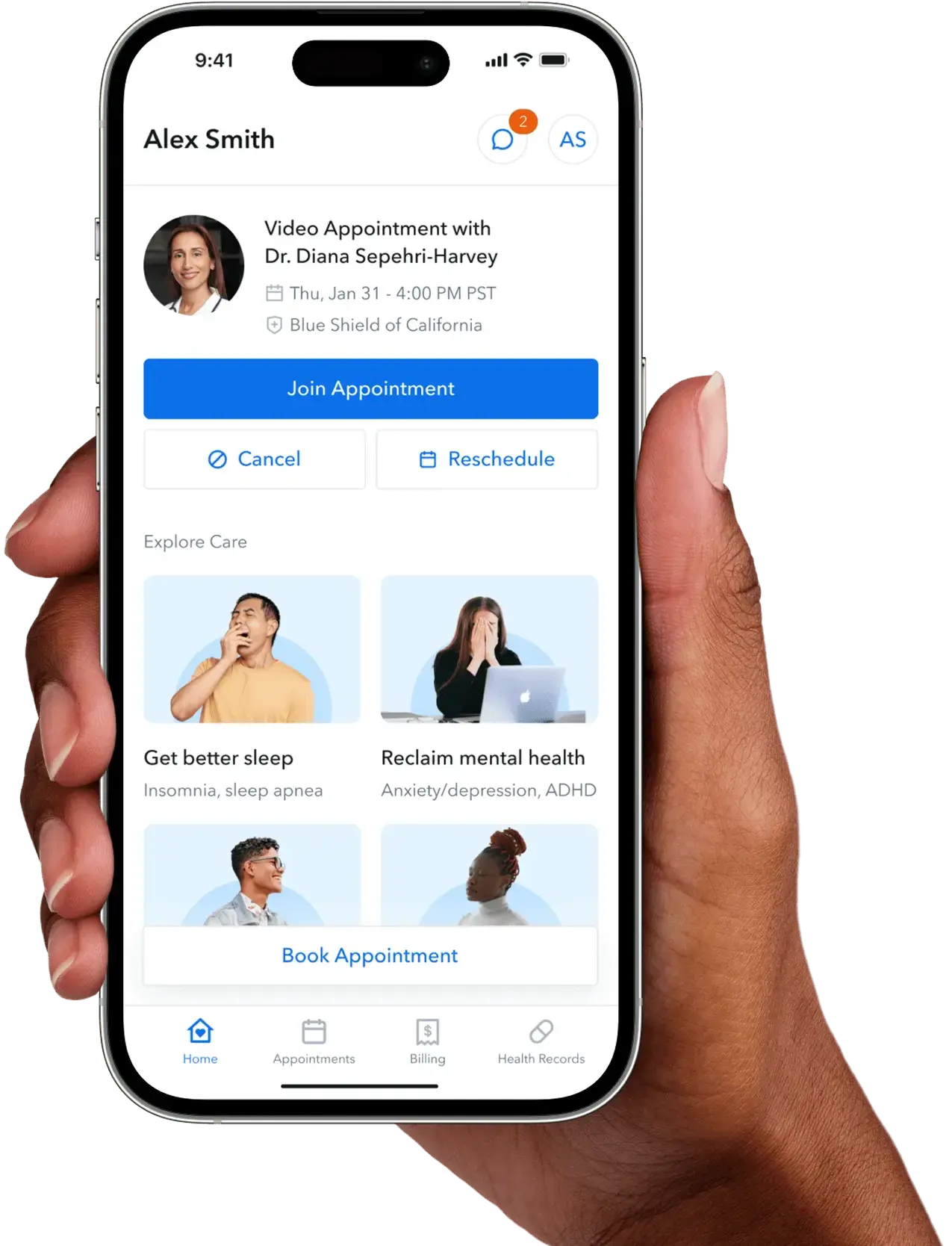
Circle Medical schedules ADHD evaluations by video, with same-day availability.
Step 4: What happens during the evaluation appointment
Your provider will then work through your symptom history, your childhood history, and how you are functioning now. Then they will go over your questionnaire answers.
Expect questions about your sleep, mood, alcohol use, and other medical conditions.
Step 5: Diagnosis, or a different explanation
Your provider will either confirm that your symptoms meet DSM-5 criteria and discuss treatment options after an ADHD diagnosis, or explain which criteria your symptoms do not meet.
If your results say you don’t have ADHD, that still rules out one explanation. Your provider will likely give you a next step: a sleep study, thyroid labs, or a referral.
What to bring to your ADHD evaluation
- Your two-week symptom log
- Report cards or anything with a teacher’s written comment
- Previous psychological, educational, or ADHD assessments
- Your medication list, including supplements
- Notes from a partner, parent, or close friend
- Insurance card and photo ID

How long does it take to get tested for ADHD?
Most adults get an answer within two to six weeks of booking an ADHD evaluation appointment. Most of that time in between is just about waiting. The appointment itself rarely runs for more than an hour.
| Route | Wait for first appointment | Appointment time | Time to an answer |
|---|---|---|---|
| Online primary care practice | Same day to a few days | 30 to 60 minutes, sometimes over two visits | Days to two weeks |
| In-person primary care office | About one to three weeks | 30 to 45 minutes | Two to four weeks |
| Psychiatrist | Median of 67 days in person, 43 days by video | 45 to 90 minutes | Two to four months |
| Neuropsychological evaluation | Weeks to months | 3 to 8 hours of testing | One to three months with the report |
Nearly half of adults with ADHD, 46.0%, have used telehealth for their condition because the waits are shorter. The provider you choose also sets what you pay.
ADHD testing costs vary by provider type
What you pay depends on who performs the evaluation and whether you use insurance.
An evaluation with a primary care provider or psychiatrist is billed as an office visit, so it usually costs a few hundred dollars before insurance.
A neuropsychological evaluation involves hours of testing and costs several times more. Many health plans cover ADHD evaluations, though coverage varies by plan and provider type.
Circle Medical is in network with many major PPO insurance plans.
Common questions about adult ADHD testing
Is ADHD testing covered by insurance?
Many health plans cover an adult ADHD evaluation, usually as a medical or behavioral health office visit. Coverage depends on your plan, the provider type, and network status. Circle Medical is in network with many major PPO plans.
Can you get tested for ADHD online?
Yes. A provider can complete a full evaluation over a live video visit, and 8.9% of adults with ADHD were diagnosed through telehealth alone. Prescribing rules vary by state.
Is there a blood test or brain scan for ADHD?
No single blood test or brain scan diagnoses ADHD, and the CDC says so plainly. Blood work and imaging may be indicated to rule out other causes, such as thyroid problems or anemia. A service marketing a brain scan as an ADHD diagnostic sits outside standard practice.
Can ADHD be diagnosed for the first time in adulthood?
Yes, and it commonly is. More than half of U.S. adults with a current ADHD diagnosis were diagnosed at 18 or older. The criteria still require several symptoms before age 12, though nobody needed to notice them.
What is the difference between an ADHD screening and a full evaluation?
A screening is a short questionnaire, such as the ASRS, that flags whether a full assessment is worth doing. A full evaluation is a clinical process: your provider interviews you, reviews your history, applies DSM-5 criteria, and rules out other causes. Only the evaluation produces a diagnosis, so treat a self-test score as a reason to book.
Getting tested is the start of the conversation, not the end of it
Whatever your evaluation concludes, you’ll leave with more information than you started with. An ADHD diagnosis gives you a framework, a treatment conversation, and language for accommodations when you’re struggling at work.
A different finding points you toward sleep, mood, thyroid function, or whatever else may have caused your symptoms.
Your care doesn’t have to stop with ADHD. As a primary care practice, we know ADHD is one piece of making you healthy.
If your symptoms are affecting your safety, your job, or your relationships, don’t wait for a convenient moment.
Circle Medical works with 300+ board-certified primary care providers and has treated 300,000+ patients, who rate their care 4.95 out of 5.
Talk to a provider about ADHD today. Circle Medical offers online ADHD treatment from board-certified providers by video, with same-day availability.


Talk to a provider about your health today
In network with most insurance plans
No memberships or hidden fees
Pay only after your appointment